
Understanding Your LPG (liquefied petroleum gas) Tank
The name of LPG (liquefied petroleum gas) indicates those blends of commercial butane and commercial propane obtained from the distillation of crude oil, from the fractionation of natural gas (which they are often contained) and from the processing of petrochemical plants. At ambient temperature and atmospheric pressure, they occur in the form of gas. Commercial Propane can be mixed with propylene, butylene, butane and ethylene. The Commercial Blend is a comprehensive set of hydrocarbons, obtained from the combination for the most part (about M 70%) of butane and isobutane and with an amount of propane equal, on average, to 30%. Suitably odorized and denatured, this mixture is sold as a domestic fuel in cylinders. For more details, visit the dedicated page here. After this brief knowledge of the LPG gas, let's move on to the tank structure of a home or office for general use. There are two ways to install the LPG tank:
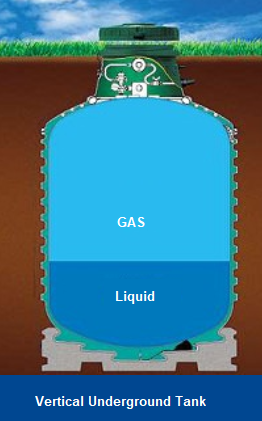
Underground Tank Figure 1 - 2 below shows a tank which is installed to underground
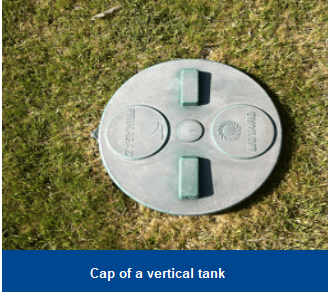
The underground tank is housed in a hole in the ground and covered with sand or debris. The area surrounding the reservoir must be free of vegetation, and tall trees are prohibited for a radius of 5 meters. A concrete slab is positioned inside the excavation to anchor the tank to avoid movement during filling. The installation must be carried out by highly specialized personnel who issue the certificate for the system's conformity at the end of the work. The LPG tanks for underground differ vertically and horizontally according to the inclination. The convenience of this type of tank is that once installed, and they are practically invisible. Only a closing lid appears that can be easily camouflaged from the outside. The underground LPG tank must be prepared for this use, and the technical characteristics must be suitable for the different conformations of the terrain. The surface of the underground tank is usually treated. A thick layer of epoxy paint covers the tank allowing it to be isolated from stray currents and the chemical-physical actions of the subsoil. The soil could be an aggressive environment and lead to corrosion of the material. In order to prevent deterioration of the metal structure, a technique called cathodic protection is used (magnesium anodes and copper electrodes). In this way, the duration of the tank is preserved for the entire period of their operation, at least 20 years. Sometimes, the metal tank is located inside a watertight polyethene container that protects it. The container is then closed with a cap that guarantees the well's perfect watertight seal where the safety and control devices are located. See Figure 3 below
The dimensions of the underground LPG tank and the necessary excavation In the technical documentation, there is always a sheet with the characteristics, instructions for use and maintenance of the system. The table shows the tank measurements and the excavation required for burial according to the capacity
The safety distances for the underground LPG tank
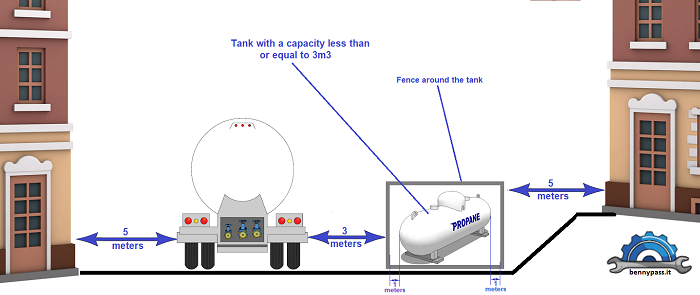
Safety distances between LPG Tanker, Tank, and Structure (building) Whoever installs these tanks must be aware of some elementary rules, and without this they cannot install the tank. Most significant interest to the future purchaser of LPG refers to the tank's distances from nearby buildings and from the tank truck that will supply it with gas. This is a very critical stage and must be considered. Furthermore, for above ground tanks, a fence must be made around the said tank, and this fence must follow the distances required by law. Figure 4 below shows the summary image:
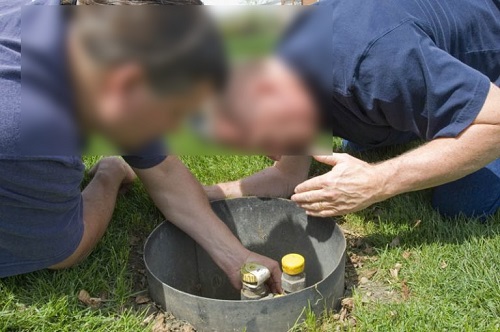
Note: If the ground is sloping, a concrete curb 20 cm high, 20 cm wide, and 1.50 meters away from the tank must be provided. Must be following also the rule that at the time of refuelling, the tanker must be connected with a ground wire to the ground to avoid any potential spark. Sometimes all of this is bypassed due to lack of time. Remember, without grounding can be catastrophic. Another critical point is the Personnel that working around the truck or the tank, the safety glasses and visor to protect the eyes is mandatory, including the safety gloves Figure 5 below show a wrong inspection without eyes protection, including the gloves. Even if they are experts, the fatality is near the door. Butane/propane are two hazardous gases, especially when the personnel working near relief valves or refill valves without protection, as in Figure 5
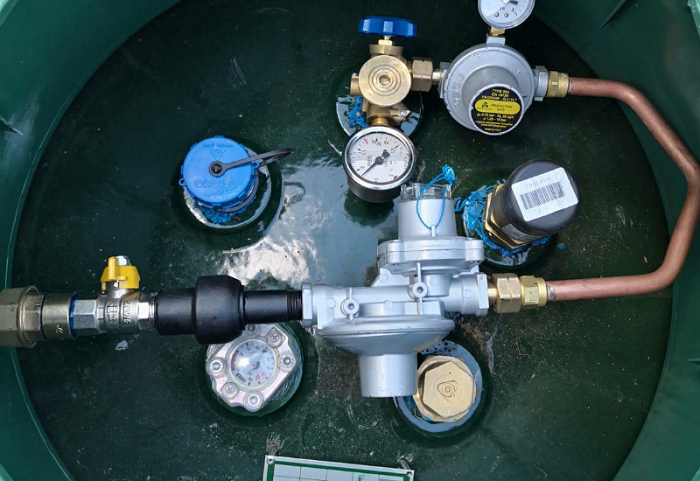
Your propane (LPG) tank may seem like a basic structure serving a simple purpose; however, you’d be surprised to learn that there’s really a lot more to it than meets the eye. Upon closer inspection, you’ll notice numerous gauges, valves, and other intricate pieces of apparatus that play an important role in making sure your propane tank operates. Before we take a look at the technicalities, it’s worth mentioning that there are several clear requirements every tank must meet to be considered compliant. A few of these include:
For more information click here
Understanding Individual parts of Your Propane Tank Now that you know the basic requirements for a compliant propane tank, let’s take a look at its individual parts:
Although propane tanks are made by many different companies and in many different sizes, all of these manufacturers must adhere to the rules set forth by the American Society of Mechanical Engineers (ASME) if their tanks are intended for use in the U.S. The tanks manufactured are designed for safety and efficiency, as well as to satisfy the requirements of compliance. There are also national, state, and local rules governing the installation of propane tanks, and you can trust Keystone Propane’s extensive expertise in upholding all codes and regulations during the installation and refill process. To find out more information about your propane tank or the regulatory codes in your area, feel free to contact a Keystone Propane representative anytime. Safety system of propane Tank and devices When you own a home or business powered by propane, knowing about propane tank safety is essential. There are certain safety features under your tank’s cover every propane user should be aware of. Your knowledge of proper propane tank safety can protect you and your family in the case of an unexpected natural disaster or potential leak. Also, learning how to detect a potential leak in your propane system is another added layer of protection. It is essential to note that consumers should never turn their propane supply back on their own. Always contact your service which provides the propane, sure they can send certified technicians to come to your home or business and do this for you. The most common sign that your propane system may be an issue is the scent of rotten eggs or a skunk’s spray. Propane, by nature, is odourless, so propane industry safety standards require producers to add an odorant. This is an additional layer of safety for the consumer. If this smell is in or around your house, there may be a leak. In some cases, customers may have a difficult time smelling propane because of age, a medical condition, or the effects of medication, alcohol, tobacco, or drugs. Although it’s rare, propane can lose its odour due to the presence of water, air or rust in a propane tank or cylinder. A leak of propane through soil can also cause it to lose its distinct odour. Because there are circumstances when the odour may not be as prevalent, it is important to call your service immediately at even the faintest smell of propane so that one of your service technicians can take a look at your system Sight – Pilot Lights your tank as a colourless gas. Because propane is invisible, it’s essential not to ignore the signs you can see. If you continually have an issue with keeping your pilot light on your gas-powered appliances lit, something more significant may be happening. Luckily, your furnace (heater) and water heater are equipped with safety features. These features are working properly if you cannot keep your pilot light, practically they are in place to alert you to a problem. An important note: When your pilot light goes out on your furnace or water heater, propane is NOT flowing, and there may be no leak. The safety mechanisms in place with these appliances close the valves and fuel flow (maybe low pressure) Lids should NEVER be locked (LPG tank) as the valve is used to shut off the entire system in an emergency and is located under the lid. The lid is designed simply to protect various valves and fittings from the elements. How Pilot Lights Work The basic idea behind a pilot light is simple. Its purpose is to provide the flame needed to light the gas coming out of the main burner. When the furnace "turns on", a valve releases gas into the burner and the pilot light ignites that gas. The way that pilot light is created is also simple. It is made by allowing a small amount of gas to come from the gas pipe through a small tube. You light the gas escaping from the tube, and it burns all the time. However, the pilot light creates a potential safety problem. If the pilot light flame were to ever blow out, the gas would keep coming out of the pilot light tube. If this gas were to collect inside your house and then ignite, it would create an explosion. To solve this problem, the pilot light tube has a valve that cuts the gas to the pilot light in the event that it ever blows out (normally should be in auto) This valve is a fascinating little piece of equipment. It has to be able to sense whether that pilot light is lit or not, and for safety reasons, it needs to be able to do that without requiring any outside electricity. How can you create a pilot light sensor that works reliably over the course of many years without any electricity? The answer to that question is ingenious. The way to do it is to use the heat of the pilot light flame to generate electricity by using a thermocouple. Thermocouples generate electricity directly from heat. They take advantage of an electrical effect that occurs at junctions between different metals. For example, take two iron wires and one copper wire. Twist one end of the copper wire and one end of one of the iron wires together. Do the same with the other end of the copper wire and the other iron wire. If you heat one of the twisted junctions with a flame and attach the two free iron wires to a voltmeter, you will be able to measure a voltage. In a pilot light, one of the junctions of a thermocouple is sitting in the pilot light's flame. The electricity that is created runs to a small electromagnetic valve and holds it open. If the pilot light blows out, the thermocouple quickly cools off. It stops generating electricity and the valve closes. To relight the pilot light, you have to push a button that opens the value manually. Then you light the pilot light and wait for the thermocouple to heat up (about 30 seconds). Once it is hot, the thermocouple is generating the electricity needed to hold the value open. Then you can let go of the button. Il problema con le spie è che sprecano molto gas. Pertanto, la maggior parte degli elettrodomestici moderni non dispone di una spia. Invece, usano una scintilla piezoelettrica per accendere il bruciatore.
|
|||||||||||||||||||||||||||||||||||||||||||||||||||||||||||||||||||||||||||||||||||||||||||||||||||||||||||||||||||||||||||||||||


+(39) 347 051 5328
Italy - Kazakhstan


09.00am to 18.00pm
About
We offer the best and economical solutions, backed by 27+ years of experience and international standards knowledge, echnological changes, and industrial systems.
Our Services
Marketing Materials


Marketing Materials1


