
|
UPS Capacitor Filters - Worning Principle
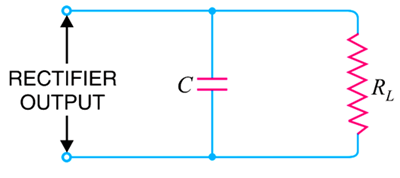
UPS capacitor filters smooth pulsating DC voltage into stable DC by charging during voltage peaks and discharging during dips. Positioned in parallel with the load, they store energy and reduce AC ripple, acting as a buffer that prevents voltage from dropping to zero. This continuous charging/discharging action provides a consistent, filtered power supply. Key Working Principles
Role in a UPS
The effectiveness of the filter depends on the capacitance value, the load resistance, and the input frequency, with higher capacitance generally resulting in lower output voltage ripple.
In an Uninterruptible Power Supply (UPS), capacitor filters function as energy reservoirs that smooth electrical fluctuations and remove noise from the power stream. Their working principle differs slightly depending on where they are located within the system.
Found in the rectification stage, these capacitors convert "pulsating" DC into steady DC power.
Located at the input and output stages, these capacitors manage the quality of the AC sine wave.
Summary of Function by UPS Stage
For long-term reliability, it is recommended to replace UPS capacitor banks every 5 to 7 years, as their ability to store charge degrades over time. You can monitor health through professional UPS maintenance services
|
|
UPS Phase-Locked Loop (PLL) - Working Principle
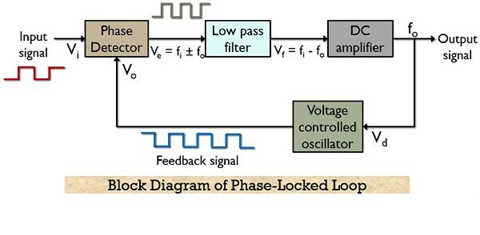
A UPS Phase-Locked Loop (PLL) synchronizes the inverter's output voltage phase and frequency with the input grid (reference) signal to ensure seamless power transfer. It acts as a closed-loop control system, typically using a phase detector, loop filter, and voltage-controlled oscillator (VCO) to reduce phase difference to zero Key Components of a UPS PLL
Working Principle
In modern digital systems, this is often achieved via a Software-based PLL (like a Synchronous Reference Frame PLL) in the microcontroller, ensuring the inverter stays in step with the grid.
In simple terms, a Phase-Locked Loop (PLL) in a Uninterruptible Power Supply (UPS) acts as a "synchronizer." It ensures the UPS's internal power matches the utility grid's frequency and phase exactly before any switching occurs.
Core Working Principle
The PLL works as a negative feedback control system that continuously compares two signals:
If there is any difference in phase or frequency, the PLL generates an "error voltage" to speed up or slow down the internal inverter until they match perfectly.
The 3 Key Components
Why Is It Critical for a UPS?
|
|
UPS H-bridge inverter converts DC to AC - Working Principle
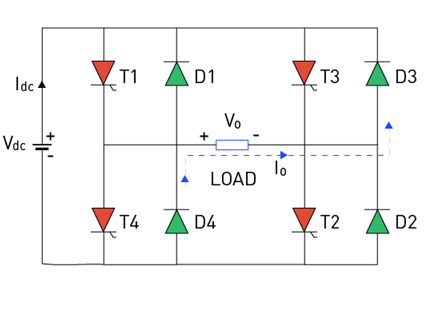
An H-bridge inverter converts DC to AC by using four switches (MOSFETs/IGBTs) arranged in an H-configuration around a load. By toggling diagonal pairs (Q1/Q4 then Q2/Q3), it reverses load current polarity, producing a square or PWM-modulated AC wave. It is highly efficient for motor control and UPS systems. Key Working Principles
The H-Bridge Inverter Stage is a fundamental power electronic circuit used to convert Direct Current (DC) into Alternating Current (AC). Its name comes from the arrangement of four switching elements that resemble the letter "H". Core Working Principle The primary goal is to alternate the polarity of the voltage across a load by controlling pairs of switches.
Key Components & Safety
Waveform Control While simple switching produces a square wave, most modern inverters use Pulse Width Modulation (PWM) to approximate a sine wave. By varying the "on-time" of the switches at high frequencies, the average output voltage can be shaped into a sinusoidal form suitable for sensitive AC appliances. |
|
UPS Output Filters (LC/LCL) - Working Principle
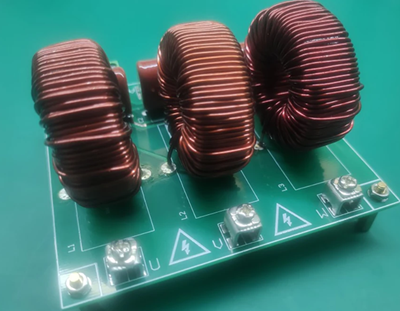
UPS output filters (LC/LCL) are passive, low-pass networks placed between the inverter and load/grid to convert high-frequency PWM switching signals into clean, sinusoidal AC voltage. They suppress switching noise, reducingTotal Harmonic Distortion (THD) by letting lower power frequencies pass while attenuating high-frequency components. Key Operating Principles
Comparison
|
|
UPS Power Factor Correction (PFC) - Working Principle
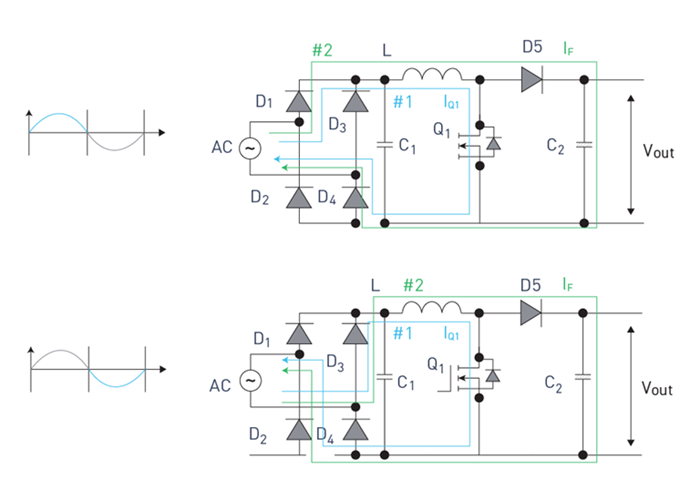
UPS Power Factor Correction (PFC) works by forcing the input current waveform to mirror the sinusoidal voltage waveform, ideally bringing the power factor (PF) to 1.0 (unity). By minimizing harmonic distortion and phase lag, Active PFC uses switching transistors (usually a boost converter) to manage input power efficiently, reducing strain on the grid and improving UPS efficiency. Key Working Principles of UPS PFC
PFC Implementation in UPS Types In modern online double-conversion UPS systems, PFC is achieved within the AC-to-DC rectifier stage. It corrects the power factor at the input to ensure a high power factor (often 0.99 or better) is presented to the utility grid, even under partial loads. In an Uninterruptible Power Supply (UPS), Power Factor Correction (PFC) is the technology used to align the input current with the input voltage to ensure the system behaves like a purely resistive load. This process maximizes energy efficiency by reducing "wasted" reactive power. Core Working Principles Modern UPS systems primarily use Active PFC, which utilizes high-frequency electronic switching to reshape the current.
Why PFC is Essential for UPS
|
Super User
Electrical

+(39) 347 051 5328
Italy - Kazakhstan


09.00am to 18.00pm
About
We offer the best and economical solutions, backed by 27+ years of experience and international standards knowledge, echnological changes, and industrial systems.
Our Services
Marketing Materials


Marketing Materials1


